About us

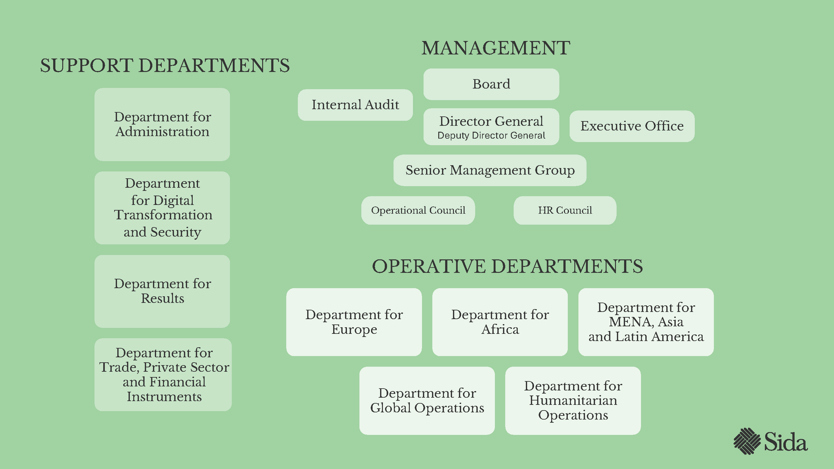
Organization

Published: Thursday, June 18, 2009

Changed: Monday, April 12, 2010

Sida works according to directives of the Swedish Parliament and Government to reduce poverty in the world. The overall goal of Swedish development cooperation is to contribute to making it possible for poor people to improve their living conditions. Sida's organization has three main pillars:

  • Policy, which is responsible for global dialogues and reaching consensus, knowledge development and advice, quality assurance and competence;
  • Operations, which is responsible for the implementation of the development co-operation;
  • Management, which is responsible for control and planning functions as well as service to the rest of the authority.

Page owner:

The Communication Department
 
Tell a friend

International Training Programmes

As part of Sida's work with capacity and institutional development Sida offers international training programmes (ITP) for participants from low-and middle-income countries in priority areas. ITP's methodology takes account of the desire to develop and reform that the participants' organization have expressed in their application to the program.

Community loan and repayment schedule. Mumbai, India.
Photo: © Simone D. McCourtie / World Bank

How to apply for funding

Sweden's support to civil society organisations, CSOs, in development countries is always channeled through a Swedish organisation. By supporting the work of CSOs, Sida hopes to promote the development of a dynamic and democratic civil society and strengthen local partner organisations.

Sida's publications

Search our publications database to find reports, evaluations, country strategies and much more.

support to the civil society
Photo: Julio Pantoja/World Bank

How Sida supports civil society organisations.

Sida's financial support for civil society organisations (CSOs) amounts to SEK 1.2 billion for 2010. It is channelled through Swedish framework organisations and their respective development partners.

Champika Subashini har trots funktionshinder startat eget företag, och blivit självständig.
Photo: Wenche Willumsen/DHR

Champika started her own business

For a poor and disabled Sri Lankan woman there is little chance to support oneself. But with the help of the Rehab Lanka project Champika Subashini, 24, from Sri Lanka was able not only to train as a seamstress but also to borrow money for her own sewing machine and start her own business.

Procurement Q&As

Q&A about procurement at Sida. What regulations apply? What if I submit after the deadline? How do I know what documents are required?